What do different Q Scores mean?
The COMPASS Q Score, the construction credit score, provides a standardized, independent assessment of a subcontractor. The Q Score is used as a consistent starting point for prequalification.
General Contractors typically view the Q Score as two broad categories based on the appropriate level of review during prequalification. Yellow Q Scores indicate a higher level of review than Green Q Scores. Within those categories, there is a differentiation with the Q Score reflecting a Subcontractor’s Credit Profile, ranging from Q1 (Outstanding) to Q7 (Poor).
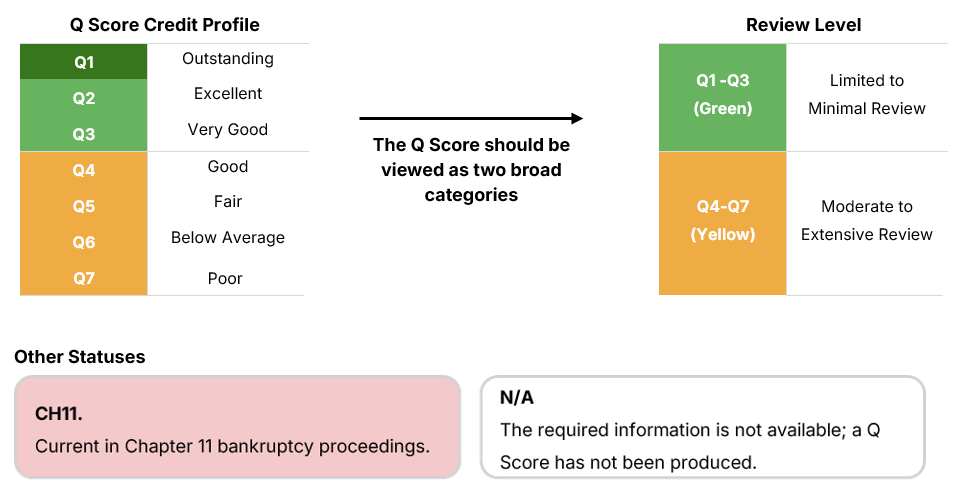
Together, the Q Score and its associated color coding distinguish subcontractor Credit Profiles and indicate the appropriate level of review.
For additional detail on the Q Score framework, Credit Profiles, and the interpretation of Q Scores, read the COMPASS Q Score Methodology here.
What Goes into the Q Score?
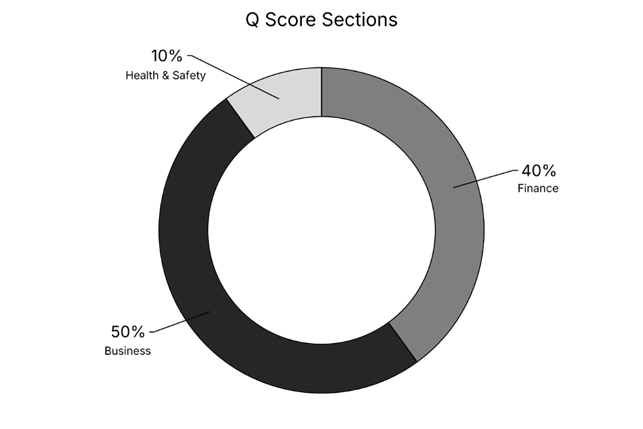
Operational expertise, financial capacity, and health & safety track record all contribute to the overall Q Score. Information from each section is assessed against industry benchmarks. The results are weighted and aggregated to produce an initial Q Score.
-
Business - 50%
Company stability, management experience, growth, diversification, backlog and revenue characteristics, legal history, and other operating indicators.
-
Finance - 40%
Liquidity, leverage, profitability, turnover, financial statement trends, and related financial measures.
-
Health & Safety - 10%
Safety programs and personnel, incident history, experience modification or comparable measures, citations, and other health & safety indicators.
Significant Risk Indicators (caps) can limit a subcontractor’s ability to achieve a Green Q Score.
For additional detail on Q Score Sections, their assigned weights, and the measures assessed within each section, read the COMPASS Q Score Methodology here.
What can limit a Q Score?
The Q Score is based on a subcontractor’s operational expertise, financial capacity, and health & safety track record. Certain conditions, “Significant Risk Indicators”, can limit the initial Q Score. When triggered, they function as caps, preventing a subcontractor from achieving a Green Q Score.
Significant Risk Indicators may include:
-
Health & Safety Concerns
Severe accidents or fatalities, material incident history, lack of required health & safety programs or personnel, or other critical safety deficiencies.
-
Legal or Regulatory Concerns
Significant disputes, repeated citations, regulatory violations, fraud-related matters, or other legal conditions relevant to subcontractor assessments.
-
Severe Financial Weakness
Very high leverage, very low liquidity, sustained losses, or other financial conditions outside defined thresholds.
-
Insolvency or Financial Distress
Bankruptcy or insolvency filings and other documented indicators of material financial distress.
-
Insufficient or Unverifiable Information
Missing, invalid, or unverified information where the absence of data prevents a complete assessment.
For additional detail on Significant Risk Indicators, Q Score caps, and how they are applied in determining the final Q Score, read the COMPASS Q Score Methodology here.
- What is considered in the Business Section?
- What does Financial Capacity Measure?
- What is considered in the Health & Safety Section?